Typical Configurations
- Custom flex geometry
- Connector-to-flex assemblies
- Filtered flex solutions
- Application-specific terminations
 Request a Quote ↗
ROUTING WITHOUT COMPROMISE
Custom flex circuit assemblies for aerospace and defense applications, combining compact routing, connector interfaces, and component integration.
Discuss Your Project →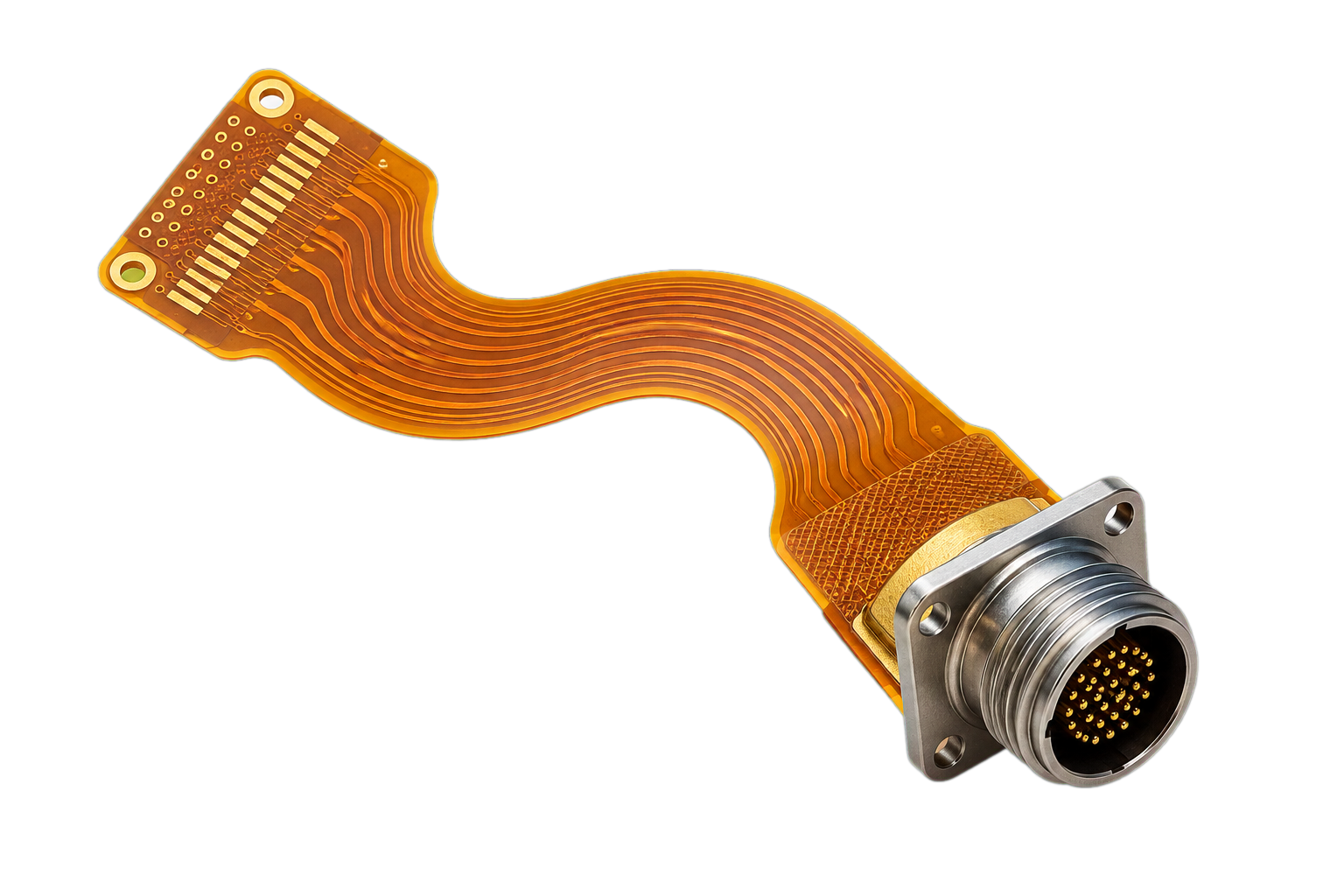 ENGINEERED TO REQUIREMENT
OVERVIEW
RCV flex interconnects reduce wiring complexity and help engineering teams route signals through confined or irregular spaces. Solutions can combine connector interfaces, filter components, and application-specific geometry in a lightweight, repeatable assembly.
CUSTOM FLEX CIRCUIT ASSEMBLIES
Custom flex interconnects replace bulky point-to-point wiring with a thin, repeatable circuit that can route signals through tight, curved, or irregular spaces. Connector interfaces, contact transitions, branch geometry, and termination features can be incorporated into one application-specific assembly.
For aerospace and defense electronics, the result can reduce wiring volume, simplify installation, and improve routing consistency in avionics, sensors, missiles, launch systems, and compact electronic modules. RCV can also integrate filter components when the interconnect must provide both signal routing and EMI control.
A flex interconnect is a flexible printed circuit assembly used to carry power or signals between components while conforming to constrained packaging.
Yes. RCV supports connector-to-flex assemblies and application-specific termination approaches designed around the mechanical interface.
Yes. Filter components and connector interfaces can be incorporated when the application needs combined routing and EMI-control functions.
Connectorized flex interconnects combine connector interfaces and flexible routing in an application-specific assembly. Component-populated configurations can incorporate filter components when signal routing and EMI control are required together.
Custom geometry supports complex routing in compact avionics, sensors, defense electronics, and other constrained assemblies. Define the mechanical envelope and installation path alongside the electrical requirements.
Provide the available design information so RCV can review the circuit and mechanical interface together.
ENGINEERING SUPPORT